What a Reliable, Professional Housekeeper Really Costs
What a Reliable, Professional Housekeeper Really Costs
Most people come into this thinking “How cheap can I get someone to clean my house?” or “Is this like $150 a month?” At your level, that frame is exactly what creates the problems you’ve already seen.
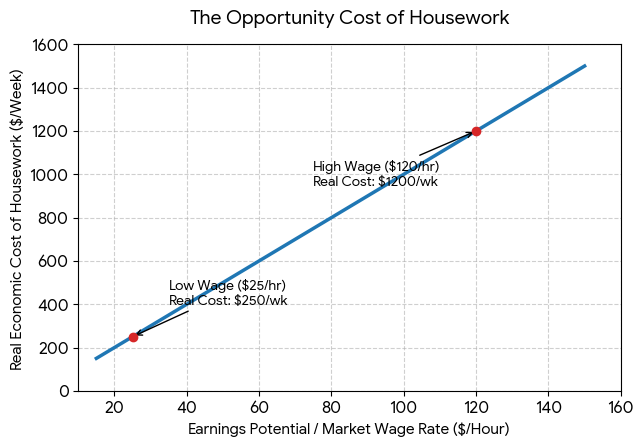
As earnings potential increases, the real cost of spending time on housework rises. Higher-income professionals face a much steeper opportunity cost for every hour spent on domestic tasks.
You’re not buying “cleaning hours.” You’re buying three things:
A lower risk of expensive homeowner mistakes (damage, injury, theft)
Consistent time and focus back every week
An environment that protects your edge instead of slowly eroding it
The goal of this article is to give you realistic price ranges and the drivers behind them, so you can look at any quote and know whether it makes sense for the life you’re actually living.
What Pro-Level Pricing Actually Looks Like
In most decent-sized U.S. metros, legit, basic insured companies (not cash-under-the-table gigs) generally fall in these rough bands. This is the bottom line what to look for if you’re legally attempting to stay above board (which I’d recommend someone high-earning and at risk does):
3–4 bedroom home, recurring standard clean (biweekly):
roughly $180–$350 per visit, depending on size, condition, and scope.4–5 bedroom high-end home, more square footage / nicer finishes:
often $250–$500+ per visit with a professional, W‑2 team.One-time deep / “reset” clean for a large high-end home:
usually 1.5–3x a typical recurring visit, because you’re catching everything up to standard.
If you see someone offering to “do it all” in a large 4–5 bedroom home for $120–$150 a visit, they’re almost always cutting corners somewhere: time on site, insurance, training, or taxes.
In the 5 bedroom homes we work with biweekly invest between $600 and $1,200 per visit, depending on size, finishes, and scope (for example, whether we’re also handling things like laundry or specific detailing).
[Image of Huang’s home or abraham cleaning]
That is well above the generic market. It’s also a different product:
On-call same day priority access so you can have us by around your schedule when you need us
Higher standards for protection so your home and liability stay protected
Competitively detailed work so your home resembles the strategic investment it is, effortlessly
The point isn’t that everyone should pay those numbers. It’s that once you’re in a large, high-finish home and you actually want a low‑risk, low‑friction, high‑standard setup, you’re no longer playing in the $150/month cleaner category.
The 3 Real Pricing Models You’re Choosing Between
When you ask “What should cleaning cost?” you’re not really picking a number, you’re picking a model.
For a typical 5‑bedroom Carmel Valley home, there are three options. Beyond a professional house cleaning service is estate management where one person works as an contractor that handles all your household needs entirely on their own:
DIY (you do it yourself)
Invoice: $0
Reality: 300–400+ hours a year of your time, plus higher odds of damage, missed deep cleans, and physical wear and tear.
Once your time is worth $250–$400/hr, this is usually the most expensive path in total economic cost.
2. Cheap / uninsured cleaners
Invoice: Looks cheaper than a professional company.
Reality: Less time spent cleaning yourself, but you take on real risk: damage, injury, theft, inconsistency, and the hassle of retraining and following up.
The bill shows up as surprise repairs, liability, and lost focus, but you do save money upfront.
3. Professional W‑2 service (fully insured, systematized)
Invoice: Highest sticker price per visit.
Reality: The lowest total cost once you add time, risk, and performance back into the equation.
You get an on-call, trusted, personalized experience that caters to your life, but does cost more upfront
For one of our standard 5‑bedroom Carmel Valley homes, here’s what those three paths roughly look like financially:
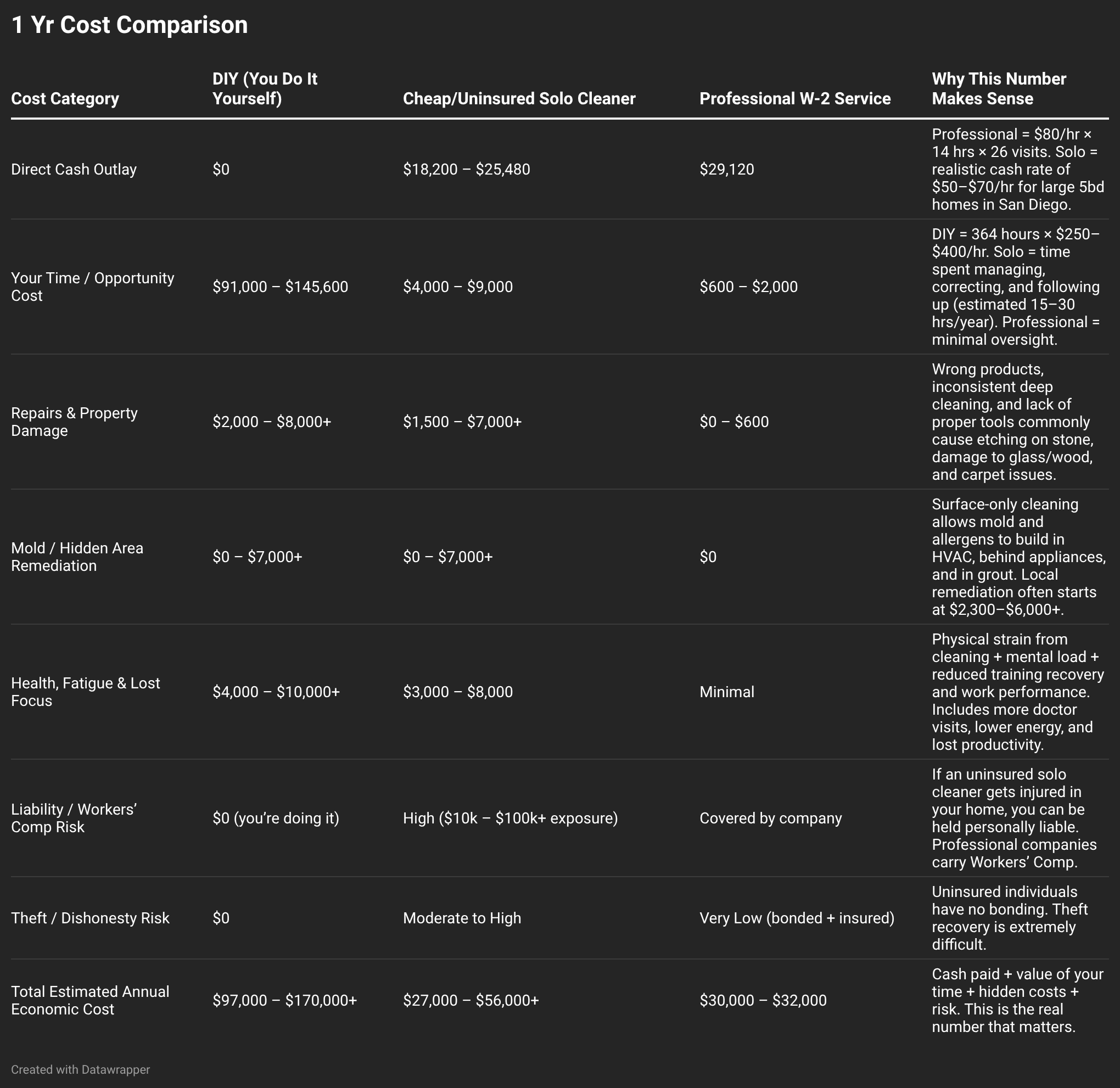
1 Year Cost Comparison of a Typical 5 Bedroom Home
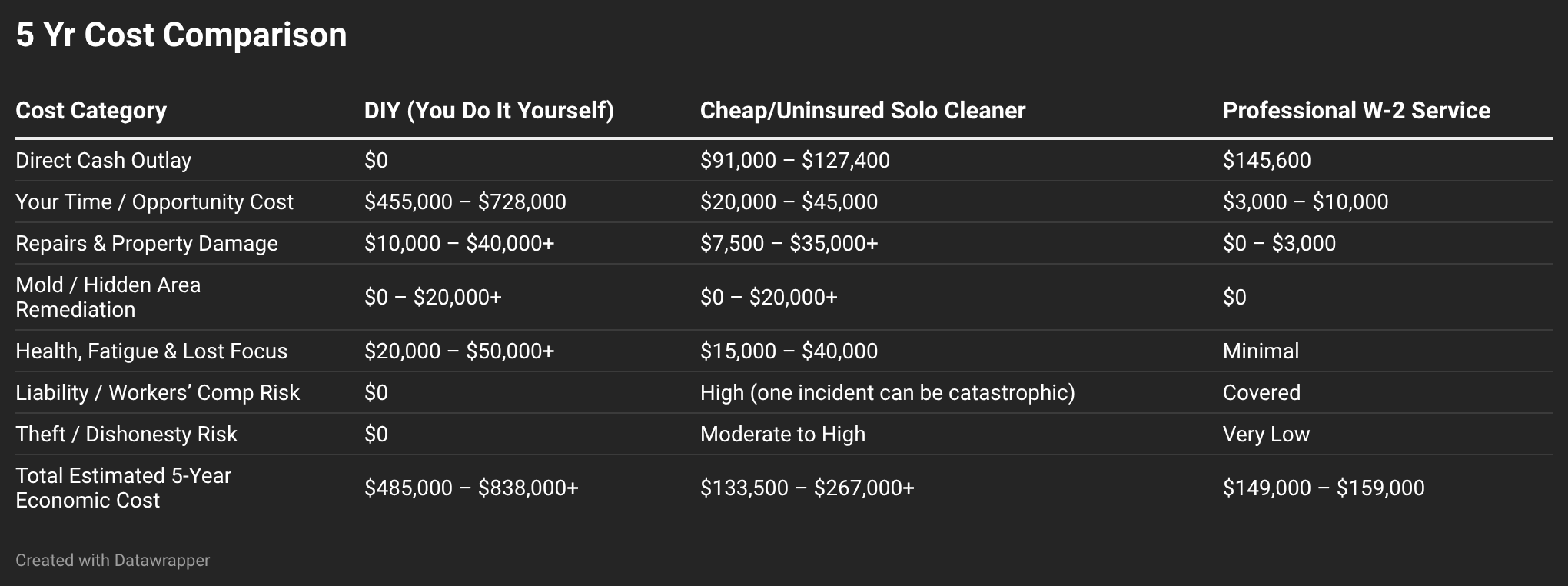
5 Year Cost Comparison of a Typical 5 Bedroom Home
If you don’t want to stare at charts, here’s the punchline:
Over 1 year, DIY comes out around $97k–$170k in total economic cost.
The cheap / uninsured route lands around $27k–$56k when you include time and risk.
A professional W‑2 setup sits roughly around $30k–$32k all‑in.
Stretch that to 5 years, and the pattern widens:
DIY: $485k–$838k+
Cheap / uninsured: $133k–$267k+
Professional W‑2: $149k–$159k
DIY “saves money” on the invoice and quietly becomes the most expensive option once you value your time. The cheap solo cleaner looks like a deal until you price in damage, inconsistency, and liability. You are put second to the cleaner or cheap company. These guys are often still learning the holes in their armor, they’re not usually bad people. It’s just a gamble if you want them to learn their next mistakes on your dime.
The professional model has the highest up‑front cash cost but the lowest total cost when you prioritize your health, home and seamless focus.
That’s the decision you’re really making. Not “$X vs $Y per clean,” but which model you want compounding in your life for the next 1–5 years.
What Actually Drives Price Up or Down
Once you’re in the right ballpark, the question isn’t “Can you do it for less?” It’s which levers you want to pull.
Here are the main drivers:
Home size & complexity
A compact 3‑bed with simple finishes is a different job than a 5‑bed with stone, glass, custom wood, high ceilings, pets, and heavy use.
More square footage and more delicate surfaces = more time, more care, more cost.
Frequency (weekly vs biweekly vs monthly)
Weekly visits are shorter and more about maintaining a high standard.
Biweekly takes more time per visit because more builds up between cleans.
Monthly or “whenever” is basically a mini deep clean each time.
You can lower per‑month spend by stretching frequency, but the per‑visit work goes up.
Scope (baseline clean vs extras)
Baseline: kitchens, bathrooms, floors, dusting, obvious resets.
Extras: laundry, bed changes, deep inside fridge/ovens, organizing, special projects.
The more you move from “clean the house” into “take my home off my plate,” the more hours and cost you’re choosing.
Protections (insurance, bonding, W‑2 vs 1099 / cash)
Full insurance, bonding, and W‑2 employees cost more than cash gigs.
That extra cost is what removes most of the “if something goes wrong, I’m screwed” downside.
Scheduling demands (odd hours, rush jobs, tight windows)
If you need very specific time windows, off‑hours, or last‑minute changes, supplying that flexibility costs more
A simple, predictable schedule is cheaper, but can be tough for active, unpredictable lifestyles
When we price a home, we’re not randomly picking a number and then “discounting.” We’re tuning these levers together:
Want to keep cost down? Simplify scope or frequency.
Want maximum convenience and protection? You’re choosing more time, more coverage, and a higher investment.
The point is to consciously pick the mix that matches your life, instead of haggling dollars off and accidentally stripping out the very things that make this worth doing.
How To Think About Levels Of Professional Service
Once you’re in the “professional, insured company” category, there are still different levels of service. It helps to know what you’re looking at when you compare quotes.
[Me standing, thinking]
1. Basic Professional Cleaning
This is a legit company with insurance and W‑2 or properly structured staff, but a fairly simple scope.
Focus is on visible areas: kitchens, bathrooms, floors, quick dusting.
Great fit for smaller homes, simpler lifestyles, or people who just want “not dirty” and are fine handling extras themselves.
2. Performance-Focused Setup
Same professional backbone (insurance, W‑2, systems), but built around protecting your time and standards.
More time per visit more tailored detail in a larger, higher-finish home.
Schedule, communication, and consistency are designed so you don’t have to think about it – this is where most high-earning men in 4–5 bedroom homes actually get that extra edge.
3. Full Estate / House-Manager Level
Goes beyond cleaning: managing vendors, overseeing projects, stocking, errands, more of a household COO.
Makes sense for very large properties or people who want a single point of contact for everything home-related.
Comes with a price tag and scope to take care of things beyond just home cleaning.
[Huang’s Home/nice home]
“Is This Overkill For Me?” / “Why Not Just Hire Someone Cheaper?”
Two questions usually come up once guys see the real numbers.
1. “Is this overkill for me?”
Sometimes, yes.
[Image of Huang’s home]
If your time isn’t actually worth much yet, or you’re in a smaller space with simple finishes, a full performance-focused setup might be more than you need right now.
Once your time is valuable, you’re in a larger, higher-finish home, and you care about performance, the math flips. At that point, not outsourcing properly is what’s overkill :
You’re spending high-value hours on low-leverage work
You’re accepting avoidable damage and liability risk
You’re letting your environment quietly tax your edge
The question becomes less “Can I handle this myself?” and more “Is this where I want my best hours and bandwidth going?”
2. “Why wouldn’t I just hire a cheaper solo cleaner?”
You can. A lot of people do.
[image of Nextdoor women housekeepers all raising their hand]
Just be clear on what you’re trading:
No or weak insurance: If they’re hurt in your home or damage something expensive, you’re often the one holding the bill.
No real systems: Scheduling by text, no checklists, no real backup when they’re sick or disappear. You become the manager.
Higher variance: Quality swings, missed spots, and more of your time spent checking, correcting, and retraining.
On the invoice, a cheap solo cleaner always looks better. Over a few years, once you price in:
Your time
The risk buckets (damage, injury, theft)
The drag on focus and recovery
…it usually ends up sitting much closer to “expensive DIY” than it looks at first glance.
A professional setup costs more up front and a lot less in total once you factor in everything else.
Get A Number For Your Actual Home
Everything above is to give you context. At some point, you need a real number for your specific house and life, not just ranges and charts.
If you want that, here’s the next step:
Fill out this short form to schedule a free in‑home Cost & Risk Check. In 30–45 minutes, we will:
Map your home, schedule, and standards
Show you the true cost of DIY, cheap help, and a professional setup for your exact situation
Give you a clear, written quote so you know what it would actually take to have this handled
No pressure, no on‑the‑spot decisions. Just straight numbers and a recommendation based on the life you’re actually living. If it makes sense, you’ll know. If it doesn’t, you’ll at least have a clear lens for evaluating any other options you look at.