The House Cleaning Blind Spot Many High-Calibur Men Have (And How It May Be Taxing Your Edge)
[Me coming through front door seeing tasks like dishes around the corner]
Unusually Common Among Founders, Traders, and High-Earning Professionals
You wrap up another strong week. The big deals moved forward, the deep work blocks delivered, and you even squeezed in solid training sessions. You pull into your driveway, step into the home you worked hard to earn, and immediately notice the dishes in the sink, a light layer of dust on your counters and shelves, you see the bathroom that could use attention before anyone comes by.
You have two choices in front of you.
Option one: spend the next hour or two doing a quick surface tidy yourself: wiping counters, running a load of laundry, hitting the obvious spots. It feels responsible in the moment.
Option two: the maid you hired shows up again. They do a decent enough job on the visible areas, but you still find yourself noticing the spots they missed, the way the kitchen counters still feel crunchy, and the fact that you’ll probably need to do a quick pass yourself later anyway.
Either way, you get it “good enough” and move on.
You head straight into your home office or the gym, ready to drop back into work or training. But your energy has shifted.
[Exhausted looking sitting at desk]
The mental clarity you had an hour ago isn’t quite the same. Deep focus that usually comes easier feels a little slow to arrive. Your body feels slightly more fatigued than it should after a solid week. Your home is supposed to be your recovery and performance asset but the clutter and natural buildup from the week is tough to ignore.
Most high-earning men never connect these dots. They assume messiness is something they can just ignore orhome maintenance is something they can handle in their spare time or a low-stakes expense that doesn’t meaningfully affect their performance. These assumptions are the blind spot.
And it’s costing more than most of them ever realize.
Author note: This article will include references to the data presented for easy reference if you would like to look into the points discussed further.
The Common Assumption
It makes complete sense on the surface. Your schedule is already filled with activities that directly drive results: client work, deals, training, and focused thinking. Compared to those priorities, cleaning or managing a cleaner feels like background operational noise rather than something that meaningfully affects your output or competitive edge.
Higher-income professionals face a much steeper opportunity cost for every hour spent on domestic tasks because that same hour could be applied to higher-value work, learning skills, recovery, or strategic thinking. What feels like a minor task on the calendar carries a significantly larger price tag.
This effect becomes even clearer when you factor in how interruptions and task switching impact performance
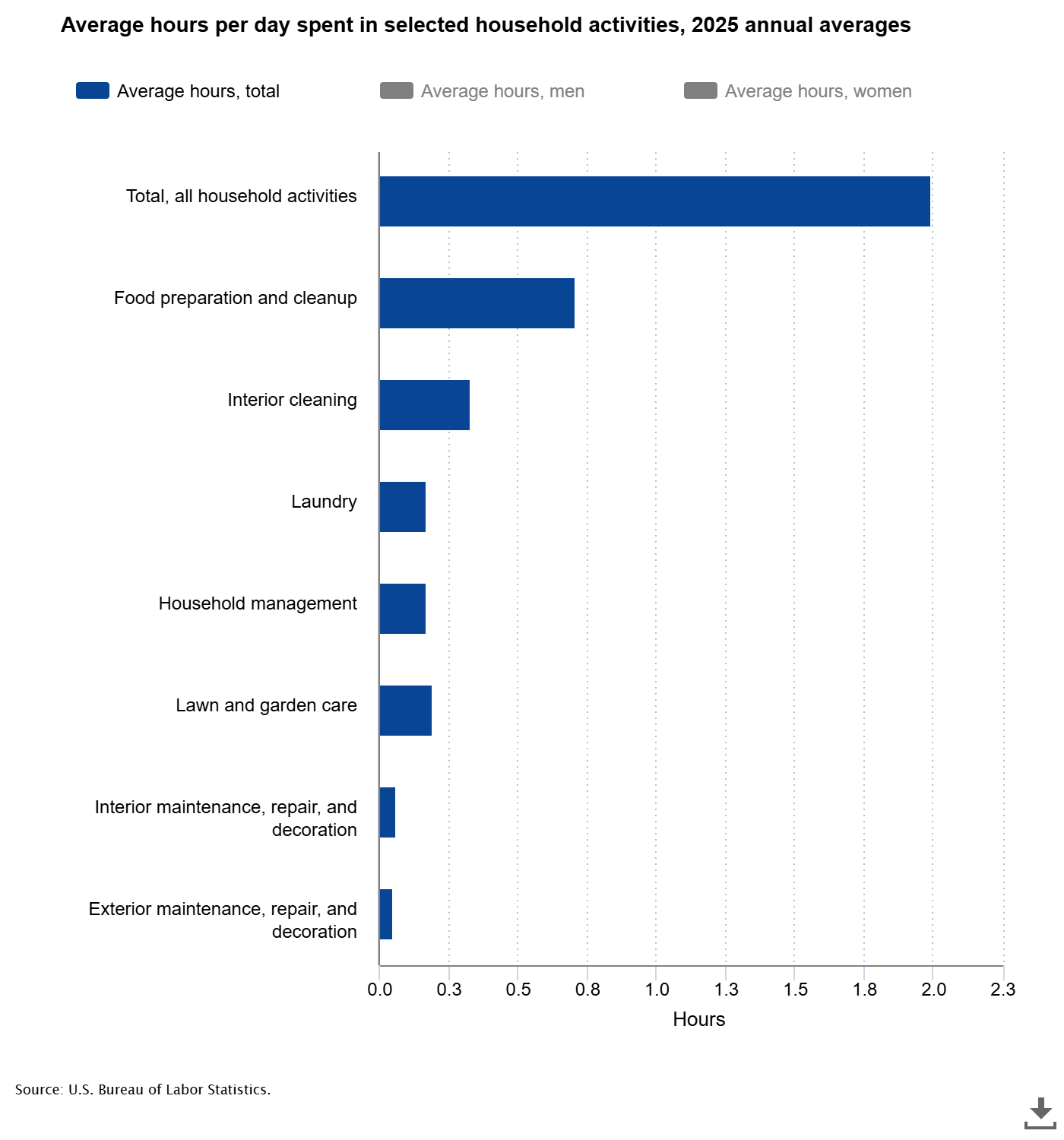
2025 National Averages For Daily Time Spent On Housework
The High-Leverage Math
Let’s put actual numbers against the time most high-earning men spend on home maintenance.
Federal data from the Bureau of Labor Statistics shows that Americans typically spend about 37 minutes daily on interior cleaning and laundry. That’s 225 hours a year, at $150-$400+/hr or $33,750-$90,000+ of annual opportunity cost, lost.
Now layer in the recovery cost. A well-known study from the University of California, Irvine found that after an interruption, it takes an average of 23 minutes and 15 seconds to fully return to the original task and regain full concentration. For someone whose focused output is measured in hundreds of dollars per hour, those repeated recovery periods compound into meaningful lost productivity over weeks and months. When those shifts happen multiple times a week, the cumulative effect on deep work blocks is substantial.
Say you decide to just not clean as much, only handle the main mess. For men in larger 4-6 bedroom homes, this can add up to cleaning debt. Areas of your home accumulate dust, smells, marks, and stains linger from past guests. Taking care of your home alone would be a tough task even if you didn’t have a demanding lifestyle.
[Cleaning in an awkward body position]
Physical fatigue compounds the issue when you do clean. Studies on domestic work link repeated bending, reaching, kneeling, and awkward postures to increased muscle fatigue and slower recovery. For someone who trains seriously, that extra strain on the body can make reduce workout quality, and extend the time needed to feel sharp again.
Some people try outsourcing help, looking online for a cheap house cleaner. But the costs can creep up in other ways. You could cycle through inconsistent help, coordinate schedules, teach standards, check results, and still end up crossing your fingers the house keeper you hired ends up being worth all that effort. Often, those house cleaners don’t even know the risks hidden in their labor which will be discussed in the following article. [link to $100k]
Then there’s the mental load. The background tracking of what needs doing, when help is arriving, and whether standards are being met. Research on cognitive household labor shows this type of ongoing mental management consumes real cognitive resources, even when you’re not physically cleaning.
The hours managing cleaning your home may feel small but when measured against the actual value of your focused time and physical recovery, they compound against you.
The Performance & Edge Erosion You May Not See
Your edge is built on long, uninterrupted blocks of deep focus, high-quality training, and clear decision-making. They are trainable capacities that depend heavily on the environment you return to every day.
[Reading book sitting on chair]
When a large home is only partially maintained, your brain is forced to process unnecessary visual information. Research in cognitive neuroscience shows that clutter and visual disorder increase activity in the visual cortex while placing extra demands on the prefrontal cortex (the area responsible for sustained attention, working memory, and creative problem-solving.) Studies have demonstrated that people working in disorganized spaces take longer to complete complex tasks and show reduced accuracy because mental resources are being used to filter out irrelevant stimuli instead of focusing on the work.
For guys whose income depends on deep thinking, clean execution, and being levels above the competition this is a steady drag on your performance.
“Good Enough” or DIY Feels Fine… Is It?
For a while, handling cleaning yourself or using “good enough” help feels fine. You’re capable, organized, and your standards carry it. Problem show up when your home is large and the finishes are expensive. A 5‑bedroom with stone, wood, glass, and multiple living areas needs the right products, deeper passes in the non-obvious areas, and knowledge on how to handle what surface or mess properly. Done incorrectly, this can result in massively expensive damages. Your home, a serious investment, may secretly be depreciating where you might not realize.
[Supplies clearly shown with labels out]
How Smart, Driven Men Can Ignore This
Part of why this blind spot sticks around is psychological, not logistical.
If you’re wired like most high‑earning men, you’ve built your life on discipline and self‑reliance. You pride yourself on being the guy who can handle things. Spending a Saturday scrubbing your own shower or “just knocking it out” late at night may feel more honorable than putting it on someone else’s plate.
There’s also an identity piece: in the back of your mind, you might still associate “having a housekeeper” with being pampered, soft, or the kind of rich you don’t feel like you are yet. So even when the math and the performance case make sense, it feels easier to keep grinding it out yourself or telling yourself you’ll sort it out later.
The truth is that the men you’d actually respect the most are ruthless about this stuff. They don’t burn elite hours on low‑leverage work, not because they’re above it, but because they’re serious about where their energy goes. For them, hiring proper help isn’t a flex, it’s a performance decision.
Small inefficiencies in home cleaning don’t stay small for long. A little extra time here, a bit more mental tracking there, a home that never quite feels fully “reset.” It becomes a compounding blind spot that inhibits growth.
If you want the full breakdown of how this shows up in property damage, injury risk, theft, health, and the math behind it, I lay it out here: [link to $100k article]
Or skip to what the right solution looks like here